I went to visit a friend. We spent hours drinking coffee and talking about all kinds of things.

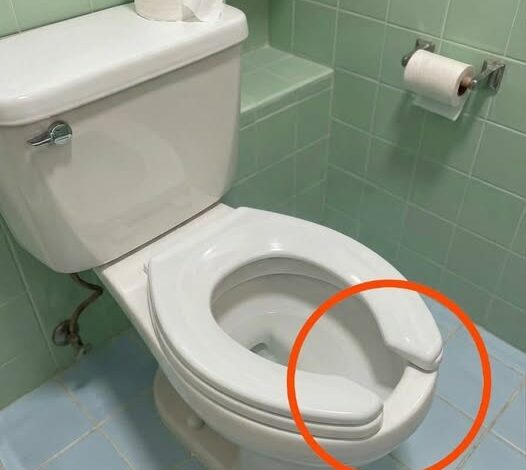
I couldn’t stop thinking about the toilet seat.
That sounds absurd when I say it out loud now.
Of all the things a person could become fixated on after visiting a friend’s house, a toilet seat shouldn’t rank very high on the list. Yet there I was, hours later, replaying the image in my mind as if it were some unsolved mystery.
The more I thought about it, the stranger it seemed.
It wasn’t broken.
It wasn’t cracked.
It wasn’t damaged.
It simply looked incomplete.
The front section was missing entirely.
Not worn away by age.
Not removed for repairs.
Just… absent.
As though someone had carefully designed a toilet seat and then decided, halfway through the process, that one piece was unnecessary.
When I first noticed it, I froze.
Not dramatically.
Just enough to stare for several seconds longer than any reasonable person should spend examining a bathroom fixture.
I tilted my head.
Looked again.
Then leaned closer.
Surely something was wrong.
Surely this couldn’t be intentional.
That’s when my friend walked in and caught me staring.
For a moment, she followed my gaze.
Then she immediately burst out laughing.
Not the polite kind of laugh people use to be nice.
Not a small chuckle.
A genuine, uncontrollable laugh that suggested I had somehow missed something everyone else understood.
“What?” I asked.
Between laughs she pointed toward the toilet.
“You’ve never seen one before?”
Apparently, I hadn’t.
Or maybe I had.
Maybe I’d walked past hundreds of them without ever paying attention.
But suddenly I felt like I’d discovered an object from another planet hiding in plain sight.
The conversation moved on.
We talked about other things.
The afternoon continued.
Yet somehow that toilet seat remained stuck in my mind.
The more my friend laughed, the more curious I became.
What was I missing?
How could something so ordinary seem so unfamiliar?
And why would anyone intentionally make a toilet seat look unfinished?
By the time I drove home, I was still thinking about it.
The image kept resurfacing.
Not because it was important.
Because it made no sense.
And humans have a funny relationship with unanswered questions.
Sometimes the smallest mysteries become impossible to ignore.
When I got home, I found my husband in the kitchen.
Without any introduction, I pulled out my phone.
“I need you to look at something.”
He raised an eyebrow.
That should have been my first clue that this conversation was going to sound ridiculous.
I showed him the photo.
He stared at it.
Then frowned.
Then zoomed in.
Then frowned even harder.
For a few moments, neither of us spoke.
Finally he looked up.
“I have absolutely no idea.”
I cannot describe the relief I felt.
At least I wasn’t alone.
For the rest of the evening, the mystery became a surprisingly entertaining household discussion.
We developed theories.
Lots of theories.
Most of them terrible.
Maybe it was damaged.
Maybe it was a specialty medical design.
Maybe it folded somehow.
Maybe it was intended for easier accessibility.
Maybe it was missing a detachable section.
At one point we even wondered whether it was some futuristic design trend that had escaped our notice.
Each explanation sounded plausible for about ten seconds.
Then it fell apart.
Hours passed.
The mystery remained unsolved.
Eventually my husband gave up.
Normal people would have done the same.
I am apparently not normal.
Later that night, curiosity got the better of me.
While the house was quiet and everyone else slept, I found myself sitting in front of a glowing screen researching toilet seats.
That sentence alone should probably concern me.
One search led to another.
Then another.
Soon I was reading plumbing websites, facility-management guides, cleaning recommendations, architectural discussions, and online forums filled with people asking the exact same question.
And finally, somewhere deep in the internet’s endless collection of oddly specific knowledge, I found the answer.
The seat wasn’t broken.
It wasn’t missing a part.
It wasn’t defective.
It had been designed exactly that way.
What I had encountered was something known as an open-front toilet seat.
And once I learned the reason behind the design, everything suddenly made sense.
The open-front style is commonly used in public restrooms, commercial buildings, schools, healthcare facilities, restaurants, offices, airports, and many other locations.
The missing front section isn’t an accident.
It’s a feature.
One of the primary reasons is hygiene.
By removing the front portion of the seat, designers reduce the amount of direct contact between users and the fixture itself. The design also creates additional space, making the seat more comfortable and practical for a wider variety of users.
Cleaning efficiency is another major factor.
Custodial staff can clean open-front seats more quickly and thoroughly because there are fewer enclosed surfaces where dirt, moisture, and bacteria can accumulate.
In facilities where dozens or even hundreds of people use the same restroom every day, even small improvements in cleaning efficiency can make a significant difference.
The design also helps reduce wear and tear.
With fewer enclosed sections and less surface area, maintenance becomes simpler and replacement costs may be lower over time.
What amazed me wasn’t the explanation itself.
It was how logical it seemed once I understood it.
Before learning the reason, the design looked strange.
After learning the reason, it seemed incredibly smart.
That realization stayed with me.
Not because of the toilet seat.
Because of what it revealed about the way we move through the world.
Most of us are surrounded by objects we use every day without ever questioning why they look the way they do.
Door handles.
Traffic lights.
Shopping carts.
Elevator buttons.
Seat belts.
Paper clips.
Light switches.
Countless inventions quietly shape our daily lives.
Yet we rarely stop to consider the thought process behind them.
Someone designed those objects.
Someone identified a problem.
Someone searched for a solution.
Someone spent time improving an experience most people would never think about twice.
The best designs often become invisible.
When something works well, we stop noticing it.
We simply use it.
Again and again.
Day after day.
Without ever asking why.
That bathroom encounter reminded me how many hidden stories exist behind ordinary things.
The world is full of small innovations that quietly solve problems.
Some improve safety.
Some improve comfort.
Some improve efficiency.
Others improve hygiene.
Many of them go completely unnoticed.
Until one day something catches our attention and forces us to look closer.
What began as a moment of confusion in a friend’s bathroom ended up becoming a surprisingly enjoyable lesson in curiosity.
Not because I learned something life-changing.
Because I was reminded that even the most ordinary objects have histories, purposes, and design choices behind them.
Sometimes curiosity starts with a profound question.
Sometimes it starts with a scientific discovery.
And sometimes it starts with standing in front of a toilet, wondering why part of the seat appears to be missing.
The lesson is the same either way.
There is far more thought built into everyday life than most of us realize.
And every once in a while, it is worth slowing down long enough to notice.
After all, the world is filled with clever solutions hiding in plain sight.
Most of them are so effective that we never think about them at all.
Until a curious moment reminds us to look a little closer.