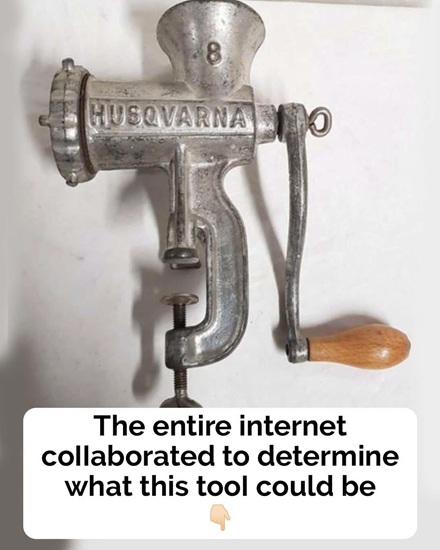
People across the internet came together to identify a mysterious object that left many puzzled.

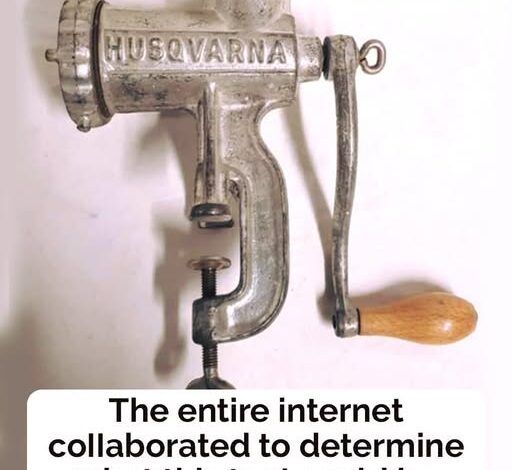
Sometimes the internet surprises us with images of objects that feel completely out of place in the modern world.
At first glance, they look unfamiliar—almost impossible to identify. They might appear in an old attic, a forgotten toolbox, a flea market, or a family collection that has been passed down through generations. Whatever the setting, the reaction is often the same: curiosity mixed with confusion.
What is it?
What was it used for?
And why does it look like that?
Fortunately, the internet has become surprisingly good at answering these questions.
Every day, online communities of enthusiasts, historians, collectors, and curious users come together to identify forgotten tools, unusual inventions, and household items that time has pushed out of everyday use. What once might have remained a mystery in a dusty corner of a garage can now be identified within hours through collective knowledge.
One such object recently caught attention online: a heavy, mechanical device made of metal, featuring a hand crank and a simple but sturdy construction. At first glance, it left many viewers puzzled.
Some guessed it was part of an industrial machine.
Others thought it might be agricultural equipment.
A few assumed it was some kind of early mechanical tool used in workshops or small factories.
But as discussions unfolded, the answer quickly became clear.
The mysterious object was a traditional manual meat grinder, also commonly known as a meat mincer.
A Tool From a Different Era
For much of the 19th and 20th centuries, meat grinders were a common fixture in kitchens around the world.
Before electric appliances became widespread, preparing food required more manual effort. Families often purchased larger cuts of meat and processed them at home. The meat grinder made this process faster, more efficient, and far more practical.
The design itself is deceptively simple.
Pieces of meat are fed into a metal chamber at the top of the device. Inside, a screw-like mechanism—turned by a hand crank—pushes the meat forward toward a perforated metal plate. As the meat is forced through the small holes, it emerges in finely ground strands.
Simple in concept.
Highly effective in practice.
More Than Just Meat
Although primarily associated with grinding meat, these devices were far more versatile than many people realize.
Depending on the attachments and design, manual grinders were also used to process:
- Fish
- Vegetables
- Fruits
- Bread or cooked ingredients
Home cooks used them to prepare fillings, spreads, sausages, and traditional recipes that required finely processed ingredients. In many households, the grinder was considered an essential kitchen tool long before modern food processors existed.
Origins and Early Development
The development of mechanical meat grinders dates back to the 19th century, a period marked by rapid innovation in household tools and industrial design.
Inventors across Europe sought ways to simplify daily tasks and reduce manual labor. Early versions of the meat grinder are often linked to German inventor Karl Drais, whose work contributed to the evolution of mechanical food processing tools.
While the design has been refined over time, the core principle has remained largely unchanged for more than a century.
A Household Essential
In an era before supermarkets and pre-packaged goods became common, food preparation was a hands-on process.
Families often worked with whole ingredients, and tools like the meat grinder played a crucial role in making that process manageable. Its clamp-based design allowed it to be securely attached to tables or countertops, ensuring stability during use.
Cast iron was a common material, chosen for its strength and durability. Many of these tools were built to last for decades, and in some cases, they still function today after restoration.
The Shift to Electric Appliances
As electricity became more widely available in homes, kitchen technology began to evolve rapidly.
Electric meat grinders eventually replaced manual versions in many households and commercial kitchens. These modern machines dramatically reduced effort and increased efficiency, allowing large quantities of meat to be processed in a fraction of the time.
Today’s electric models often include multiple grinding plates, attachments for sausages, and adjustable settings for different textures. What was once a purely manual task has become largely automated.
Why Some People Still Use Them
Despite technological advances, manual meat grinders have not completely disappeared.
Some people continue to use them for practical and personal reasons, including:
- Greater control over ingredients
- Preference for fresh, homemade food
- Avoiding additives or preservatives
- Nostalgia or traditional cooking methods
For many home cooks and enthusiasts, the manual process is not just functional—it is part of the experience.
A Glimpse Into the Past
Objects like the meat grinder often spark curiosity because they represent a way of life that has largely faded from everyday experience.
To younger generations, they may appear strange or even confusing. But to earlier generations, they were essential household tools, deeply tied to daily routines and survival.
This contrast is part of what makes them so fascinating today.
The Internet as a Modern Archive
The popularity of these identification posts highlights something interesting about modern digital culture: the internet has become a living archive of forgotten knowledge.
Where one person sees an unidentified object, thousands of others may recognize it instantly. Through collaboration, discussion, and shared memory, communities help preserve an understanding of everyday history that might otherwise be lost.
Conclusion
The meat grinder is more than just an old kitchen tool.
It is a reminder of how people once worked, cooked, and lived before modern convenience reshaped daily life.
Its simple mechanical design reflects a time when efficiency depended on physical effort, and innovation focused on solving practical problems in the home.
Today, when such objects resurface online, they serve as small but powerful reminders of how quickly technology evolves—and how easily familiar tools can become mysteries to future generations.
What was once a household essential is now a curiosity.
And yet, its purpose remains a perfect example of human ingenuity: turning simple mechanics into something that made everyday life easier for generations.