Most people think of home as the safest and most familiar place in their lives.
It is where routines happen without much thought, where ordinary sounds bring comfort, and where surprises are usually small things like misplaced keys, forgotten laundry, or a chore left unfinished.
That is why finding something strange inside your own house can feel so unsettling.
When an unfamiliar object appears in a place where it clearly does not belong, the mind often moves faster than reason. Before you have facts, you have questions. Before you have answers, you have fear.
What began as a normal afternoon of cleaning quickly turned into a mystery that held our attention for hours. By the time it was over, we had learned something unexpected about curiosity, imagination, and the quiet wonders of the natural world.
The day started in the most ordinary way.
The house was calm, and my husband and I had decided to catch up on cleaning we had been putting off for too long. He took charge of the kitchen, sorting through counters, wiping down surfaces, and tackling the kind of deep cleaning that always seems easier to postpone.
I headed for the bathroom.
It was one of those rooms that had been neglected during a busy stretch of life. I started with the sink, then moved to the mirror, the shelves, the corners, and finally the baseboards. With cleaning supplies beside me and a long list of tasks in my head, I was focused on finishing the job.
Then I saw it.
A tiny flash of bright green near the floor.
At first, I thought it was nothing important. Maybe a bit of plastic. Maybe part of a package. Maybe some tiny object that had fallen and become wedged in the narrow gap where the tile met the wall.
But when I leaned closer, I realized it was not anything I recognized.
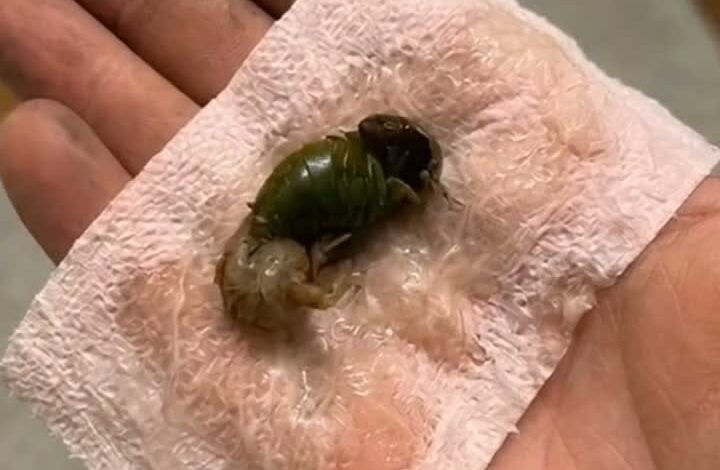
The object was small, about the size of a thumbnail, but its color made it impossible to ignore. It was a vivid green, almost chartreuse, standing out sharply against the pale bathroom floor. It was tucked deep into the narrow space near the wall, as if it had been placed there deliberately.
The longer I looked at it, the stranger it seemed.
It was not smooth.
It was not round.
It had ridges and sections, almost like tiny armor. Its surface looked patterned and structured in a way that seemed too detailed to be accidental. There was something about it that looked natural, yet unfamiliar.
For a moment, I simply stared.
Then the questions began.
What was it?
How had it gotten inside?
Had it been carried in by something?
Was it an insect egg case?
Was it dangerous?
Were there more of them hidden somewhere else?
The object itself was completely still, but somehow that made it feel even more unsettling. It did not give us any clue about what it was. It just sat there, bright and strange, turning an ordinary bathroom corner into a scene from a mystery.
I called my husband.
When he came into the bathroom, he stopped almost exactly the way I had. He stared at the object, then looked at me, and immediately agreed that whatever it was, it did not seem like something that belonged inside the house.
Neither of us wanted to touch it.
For several minutes, we stood there at a cautious distance, studying it as though it might suddenly move.
That is the strange power of the unknown. Something tiny can feel enormous when you do not understand it. Without knowledge, imagination takes over. And imagination rarely begins with the calmest explanation.
We wondered if it belonged to some insect.
We wondered if it might hatch.
We wondered if it was a warning sign of a bigger problem.
Every theory seemed possible because we had no real information.
Eventually, curiosity became stronger than fear.
My husband found a tissue and an empty glass jar. Moving carefully, he lifted the object from the gap and placed it inside the jar.
Nothing happened.
It did not twitch.
It did not open.
It did not react at all.
It simply rested at the bottom of the jar, looking every bit as mysterious as it had on the bathroom floor.
We carried it to the kitchen table and placed it beneath a bright lamp. Under better light, it became even more interesting. The ridges across its surface were delicate and precise. The sections looked almost sculpted. It seemed far too complex to be trash, but too unfamiliar for either of us to identify.
So the search began.
We opened our phones and started looking through image results, nature guides, insect websites, and identification forums. At first, the search only made things more confusing. There were too many possibilities. Some looked similar but not quite right. Others were disturbing enough to make us wish we had never searched at all.
For a while, each new possibility created more questions than answers.
Was it a cocoon?
A chrysalis?
An egg sac?
A beetle case?
Something from a plant?
The longer we searched, the more determined we became. The cleaning project was forgotten. The bathroom could wait. Solving the mystery had become the most important task of the day.
Then, finally, we found a match.
The strange green object was not dangerous.
It was not toxic.
It was not a sign of an infestation.
It was a beetle pupa.
That tiny object that had caused so much concern was actually part of one of nature’s most fascinating processes: metamorphosis.
Inside that protective outer form, an insect was changing. What looked strange and almost alien to us was simply a stage of life, a quiet transformation taking place in miniature. The ridges and segmented surface were not threatening. They were part of a natural structure designed to protect the developing beetle until it was ready to emerge.
The moment we understood what it was, the fear disappeared.
Relief came first.
Then laughter.
We had spent hours imagining alarming explanations for something harmless and remarkable. The object had not changed at all. Only our understanding of it had changed.
That realization stayed with me.
Before we knew what it was, the pupa seemed frightening. After we identified it, it seemed beautiful. The difference was not in the object. It was in the story we had attached to it.
Instead of throwing it away, we decided to move it outside. We carefully placed it in a sheltered part of the garden beneath a thin layer of mulch, where it could remain protected and continue its transformation undisturbed.
By then, the mystery had become less about the object itself and more about what it had taught us.
Fear often grows in the space where knowledge is missing.
When we do not understand something, our minds try to protect us by imagining danger. Sometimes that caution is useful. But sometimes it turns ordinary mysteries into unnecessary fear.
Curiosity offers another path.
Instead of assuming the worst, curiosity asks questions. It looks closer. It searches for answers. It allows something unfamiliar to become understandable.
That tiny green object in the bathroom corner reminded us that the natural world is always closer than we think. It does not only exist in forests, gardens, fields, or parks. Sometimes it appears inside our homes, tucked into forgotten corners, waiting to be noticed.
What began as a strange discovery during a simple cleaning session became a small lesson in wonder.
Not every unfamiliar thing is a threat.
Not every mystery is something to fear.
Sometimes what looks strange at first is simply life unfolding in a form we do not yet recognize.
And sometimes, the most surprising discoveries are not found far away at all.
Sometimes they are hidden beside the baseboard, quietly waiting for someone to look closely enough to understand.