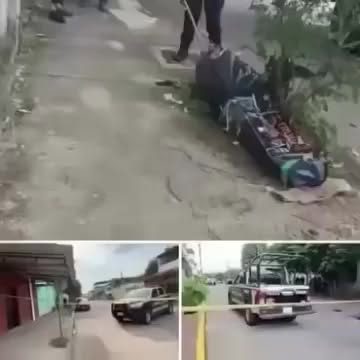
The neighbors would never forget the sirens.
Even long after the street fell silent again, long after the flashing lights disappeared from the pavement and the yellow tape was removed from the front yard, the memory of that night remained. People remembered the harsh glow of red and blue lights reflecting off windows. They remembered the police cruisers lined along the curb, the ambulance doors standing open, and the officers moving carefully across the lawn with expressions that told everyone watching that something terrible had happened inside.
Residents stood on porches in coats and slippers, their faces pale with confusion and fear. Some whispered to one another. Others said nothing at all. No one wanted to believe that such horror could unfold in a neighborhood where people knew each other’s cars, waved across driveways, and trusted the quiet after dark.
That house had once been ordinary.
A family lived there.
There had been porch lights in the evening, laughter through open windows, groceries carried in from the car, holiday decorations unpacked each season, and the familiar sounds of daily life. To anyone passing by, it was just another home on a peaceful street.
But in one night, everything changed.
The home that had once represented warmth and routine became the center of a homicide investigation. The yard became a crime scene. The street became a place of stunned silence. And a family that had once filled the house with life was suddenly gone in a way no one could understand.
For the father, the loss was beyond language.
He had left home earlier that day believing he would return to the same world he had always known. There had been no warning. No final sign. No moment that told him to hold on longer, speak more gently, or memorize every detail before it vanished. The morning goodbye had seemed ordinary, the kind people repeat every day without imagining it could be the last.
When he came back, the life he knew had been destroyed.
The people who gave shape and meaning to his days were no longer there.
In the first hours, grief arrived before understanding.
He stood beneath the flashing lights while officers asked questions, while neighbors watched from a distance, while the entire world seemed to move with a terrible urgency around him. But he felt frozen. His mind could not accept what his eyes were being forced to see. Someone spoke to him, then someone else. He answered when he could, but every word felt distant, as though it belonged to another person in another nightmare.
Nothing made sense.
Not the police tape.
Not the voices.
Not the silence inside the house.
Not the idea that the people he loved most could be taken from him so suddenly.
By morning, the neighborhood was no longer the same.
People who had once chatted casually by mailboxes now spoke in low, careful voices. Curtains shifted as residents looked toward the house, unable to reconcile its familiar exterior with the tragedy that had occurred inside. Parents kept their children closer. Doors were locked earlier. Porch lights stayed on longer. The sense of safety everyone had taken for granted had been broken.
The house remained standing, but it no longer looked ordinary.
It had become a reminder that tragedy does not always announce itself from far away. Sometimes it enters the most familiar places. Sometimes it changes everything before anyone has a chance to stop it.
For the father, the days that followed blurred into one another.
There were funeral arrangements to make when there should have been family plans. There were phone calls with relatives who could barely speak through their tears. There were decisions no grieving person should ever have to make. Every conversation seemed to circle back to loss, and every room inside the home carried a memory he was not ready to face.
A chair tucked beneath the table.
A coat still hanging near the door.
A favorite mug in the cabinet.
A photograph on the wall.
Small, ordinary objects became unbearable because they proved that life had been interrupted, not gently faded. The world inside the house had stopped mid-breath.
Detectives worked carefully to reconstruct what had happened.
They reviewed evidence, interviewed neighbors, examined timelines, checked records, and searched for any clue that might explain the unthinkable. They looked for motive. They looked for opportunity. They looked for anything that could turn chaos into a sequence of facts.
But answers did not come quickly.
And for the father, waiting became another kind of pain.
In the absence of certainty, his mind returned again and again to the days before. He replayed conversations. He searched for changes in tone, strange pauses, worries he might have missed. He wondered whether someone had seemed afraid, whether a warning had been overlooked, whether a small detail might have meant more than he realized at the time.
Grief has a cruel way of turning memory into interrogation.
It makes people search the past for doors that no longer open.
It asks impossible questions.
What if I had stayed?
What if I had called?
What if I had noticed something?
What if I had known?
But some questions offer no mercy. They remain unanswered, returning in the quietest hours, waiting beside the bed at night and following him into each empty morning.
As the investigation continued, the community tried to support him.
Neighbors brought food, though he could barely eat. Friends sat with him when there was nothing useful to say. Family members stayed close, afraid of leaving him alone with the weight of what had happened. People offered help with errands, paperwork, meals, and phone calls. They wanted to do something, anything, to make the grief less impossible.
But he soon learned that certain pain cannot be carried by anyone else.
Others can stand nearby.
They can witness it.
They can soften the silence.
They can remind a person that he is not completely alone.
But they cannot take the loss out of his chest.
They cannot restore what was taken.
They cannot return the house to what it had been before.
The father also came to understand that justice, even if it arrived, would not undo the damage. An arrest would not bring back laughter around the dinner table. A conviction would not restore birthdays, holidays, bedtime conversations, or the countless small moments that make a family feel whole. No verdict could reverse the moment that divided his life forever.
Before.
And after.
Before, when the future still seemed open.
After, when every day became an act of survival.
Still, he held onto one purpose.
Memory.
He refused to allow the people he loved to be remembered only for the way they died. They were not just names in reports. They were not only victims in an investigation. They were human beings with personalities, dreams, habits, jokes, favorite songs, private hopes, and lives that had mattered long before the night the sirens came.
So he spoke about them.
He shared stories.
He kept their photographs close.
He remembered the sound of their laughter, the warmth of their presence, the ordinary routines that once seemed too small to notice and now felt sacred.
He wanted the world to know that the crime was not the whole story.
Their lives were the story.
Their love was the story.
The joy they brought into his life was the story.
Over time, the house became a painful landmark in the neighborhood. People passed it more quietly than they used to. Some avoided looking at it directly. Others paused for a moment, remembering the family that had once lived there and the night everything changed. The street eventually returned to its routines, but not completely. Something invisible remained, a quiet awareness that safety could never again be taken for granted in quite the same way.
The sirens faded from the street.
But they did not fade from memory.
For the father, the search for answers continued. Some days brought updates. Other days brought only silence. Hope and frustration moved together, neither strong enough to defeat the other. He learned to live with waiting, though he never made peace with it. He learned that grief does not move in a straight line. It comes in waves, sometimes expected, sometimes sudden.
It can arrive in public.
It can arrive in silence.
It can rise from a familiar smell, an empty chair, a remembered phrase, or the sight of something left exactly where someone placed it long ago.
And yet, he kept going.
Not because the pain disappeared.
Not because the questions stopped.
Not because time made the loss acceptable.
He kept going because the people he loved still mattered.
Because love does not end when life is taken.
Because remembrance became his way of refusing to let darkness have the final word.
The community would always remember the night of sirens and flashing lights. They would remember the cruisers, the tape, the officers, and the fear that settled over the street. But he would remember more than that.
He would remember who they were before that night.
The laughter.
The warmth.
The ordinary mornings.
The quiet evenings.
The voices that once filled the rooms.
The small moments that now felt priceless.
And as long as he carried those memories, the people he loved would never be reduced to the tragedy of their deaths. They would remain what they had always been to him.
His family.
His heart.
His reason to keep searching, keep speaking, and keep honoring the life they had shared.
He knew that justice mattered.
He knew that truth mattered.
But he also knew that memory mattered too.
Because the people taken from him deserved more than sorrow. They deserved to be remembered in full. They deserved to be spoken of with love. They deserved a legacy stronger than the violence that ended their lives.
The night changed everything.
But it did not erase them.
And as long as he continued to carry their names, their stories, and their love forward, the darkness of that night would never be the only thing left behind.