“Every Saturday at 2 PM, a mysterious biker would quietly sit at my late wife’s grave for an hour. For months, I watched in confusion and frustration—until the shocking truth about his devotion revealed a side of her I never knew.”

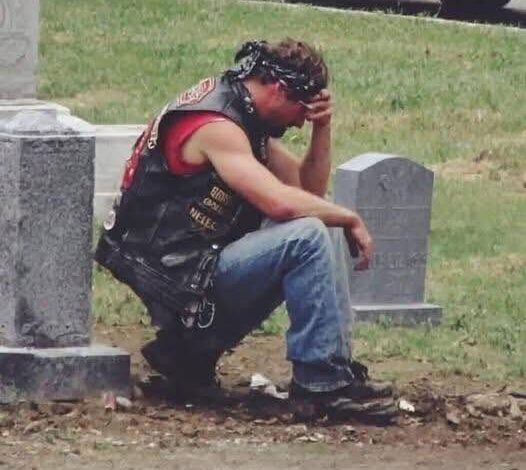
Every Saturday at exactly two o’clock, the biker came.
I first noticed him almost by accident. I had been sitting in my car at the edge of the cemetery, unable to bring myself to leave after visiting my wife Sarah’s grave. Grief had made strange rituals out of ordinary things. I would bring fresh flowers, clean the dust from her headstone, sit beside her for as long as I could bear, and then retreat to my car, where I stayed until the ache in my chest became quiet enough for me to drive home.
That was when I saw him.
A motorcycle rolled slowly through the cemetery gates, its engine low and controlled, not loud or disrespectful like I might have expected. The rider wore a black helmet and a worn leather jacket. He followed the same narrow path between the rows of headstones, then stopped beneath the old maple tree not far from Sarah’s grave.
At first, I barely paid attention. People came to cemeteries for all kinds of reasons. Everyone there was carrying some private sorrow.
But then he walked straight to Sarah.
He removed his helmet, tucked it under one arm, and stood silently in front of her headstone. For a long moment, he did not move. Then he lowered himself onto the grass beside her grave and sat there, completely still.
I remember gripping the steering wheel.
I thought he had made a mistake. Maybe he was looking for another grave nearby. Maybe he had misread the name. Maybe grief had blurred his memory the way it often blurred mine.
But the next Saturday, he came again.
Same time. Same motorcycle. Same maple tree. Same silent walk to Sarah’s grave.
Then the next Saturday.
And the next.
For six months, I watched him.
Every visit was exact, reverent, and unwavering. He never arrived late. He never rushed. He never brought flowers, photographs, candles, or notes. He never spoke loudly enough for me to hear, and most days he did not appear to speak at all. He simply sat beside her headstone with his helmet resting in the grass, staring down as if he were listening to something only he could hear.
After exactly one hour, he would place his hand gently on the marble. Then he would exhale.
That sound haunted me.
It was not theatrical. It was not forced. It was the kind of breath that comes from a place deeper than words, the kind that escapes when someone is trying not to fall apart. I knew that sound because I had made it myself too many times.
It was grief.
Real grief.
And that was what made me angry.
Who was this man, and why did he mourn my wife like that?
At first, I told myself there had to be a simple explanation. Maybe he had worked with her. Maybe she had helped him through the charity events she used to volunteer for. Maybe he was a distant relative I had never met.
But Sarah and I had been married for twenty-one years. We had shared a home, a daughter, bills, vacations, arguments, inside jokes, and the quiet routines that make up a life. I thought I knew the people who mattered to her.
Yet here was a stranger visiting her grave more faithfully than some of her own family.
The confusion slowly turned into resentment.
I hated myself for it, but I could not stop wondering. Had Sarah kept something from me? Was there a part of her life I had never known? Had this man loved her? Had she loved him? Every unanswered question felt like an intrusion into the sacred space of my grief.
I began arriving earlier, watching from my car before he came. I told myself I was only trying to understand, but the truth was uglier than that. I was suspicious. Jealous, even. Jealous of a man sitting beside my dead wife, grieving her with a devotion I could not explain.
One Saturday, I finally decided I had suffered in silence long enough.
When the biker arrived, I waited until he had settled beside the grave. Then I stepped out of my car and began walking toward him. My heart pounded with each step. I had rehearsed what I would say. I planned to ask who he was, what he wanted, and why he kept coming to my wife’s grave as though he had some claim to her memory.
But when I got close enough, the words died in my throat.
His shoulders were shaking.
He had one hand pressed against the grass beside Sarah’s headstone, and his head was bowed so low that I could not see his face. He was crying, not loudly, not dramatically, but with the quiet brokenness of someone who had been holding himself together for too long.
I stood there only a few feet away, suddenly ashamed.
Whatever reason had brought him there, his pain was real.
I turned around and walked back to my car without saying a word.
That image stayed with me all week. I saw it when I tried to sleep. I saw it while making coffee in the kitchen Sarah used to dance through on Sunday mornings. I saw it when I passed her empty side of the closet. The anger was still there, but it had changed shape. It was mixed now with curiosity, guilt, and something close to fear.
The next Saturday, I returned with a different kind of determination.
This time, I would not approach him as an enemy.
I waited until his hour was nearly over. When he placed his hand on Sarah’s headstone, I stepped forward.
“Excuse me,” I said.
He turned slowly. His face was older than I had expected, lined and tired, with eyes that looked like they had seen too many hard years.
“I’m Sarah’s husband,” I said.
For a moment, he simply looked at me. Then he nodded, as if he had known this conversation would come eventually.
“My name is Mark,” he said quietly.
I waited.
He looked back at Sarah’s grave and swallowed hard.
“She saved my life.”
The words were so simple that I almost did not understand them.
Mark told me the story slowly, with long pauses between sentences. Two years earlier, before Sarah got sick, he had been in the darkest place of his life. He had lost his wife, lost his job, and nearly lost himself to addiction. One evening, he found himself standing on a bridge, convinced there was nothing left for him.
Sarah had been driving home from work when she saw him.
Most people might have kept going. Some might have called for help and stayed at a distance. But Sarah stopped.
She got out of her car and walked toward him carefully. She did not panic. She did not lecture. She did not tell him that everything would magically be fine. She simply asked his name.
Then she stayed.
For hours.
She sat with him on the cold concrete and listened as he told her everything he thought no one could bear to hear. She talked to him about pain, about loss, about the way grief lies to people and tells them they are alone. She told him about me, about our daughter, about the small stubborn reasons she believed people had to keep living even when life felt impossible.
“She didn’t act scared of me,” Mark said, his voice breaking. “She didn’t treat me like I was broken beyond repair. She just stayed.”
Eventually, emergency responders came. Mark got help. Real help. Treatment, counseling, support groups, the hard slow work of rebuilding a life he had almost thrown away.
He said Sarah checked on him afterward. Not constantly, not in a way that made him feel like a project, but enough to remind him that someone cared whether he made it. She encouraged him when he relapsed. She celebrated when he got sober again. She told him that surviving was not a single decision, but one he might have to make many times.
“She never told you?” he asked.
I shook my head, unable to speak.
Of course she hadn’t.
That was Sarah.
She had never been interested in being admired for kindness. She simply gave it away and moved on, as if compassion were as ordinary as breathing.
Mark looked down at the headstone.
“When I heard she was gone, I didn’t know what to do with it,” he said. “I’m alive because of her. I have a job again. I have a place to live. I talk to my sister now. I go to meetings. I wake up every morning because your wife stopped her car when everyone else kept driving.”
His voice trembled.
“So I come here. Not because I think I have a right to. Just because I need her to know I’m still trying.”
Something inside me broke open then.
For months, I had seen him as an intruder. A threat. A mystery that made my grief feel less secure. But he was not there to take anything from me. He was there because Sarah had given him something I had not even known about.
A reason to live.
I sat down beside him.
Neither of us spoke for a while.
The cemetery was quiet except for the wind moving through the maple leaves. For the first time, I did not feel like Sarah’s grave belonged only to my sorrow. It was also a place where the evidence of her goodness had gathered.
After that day, Mark and I began sitting together every Saturday.
At first, our conversations were awkward. We were two men connected by one woman and two very different kinds of grief. I told him about the Sarah who sang off-key in the car, burned toast because she got distracted reading, and cried during commercials about lost dogs. He told me about the Sarah who sat beside him on a bridge and refused to let him disappear.
Piece by piece, we gave each other parts of her.
Some Saturdays, we talked for the entire hour. Other Saturdays, we said almost nothing. The silence no longer felt threatening. It felt shared.
Over time, I learned more about Mark’s life. He had been sober for over a year. He volunteered at a recovery center. He had started repairing motorcycles again, something he had loved before grief and addiction swallowed him. He still had hard days, but he was building something steady.
And I began healing too.
Not all at once. Grief does not vanish because someone tells you a beautiful story. But something in me softened. I stopped guarding Sarah’s memory as if love were a limited thing. I realized that the fact she had mattered deeply to someone else did not lessen what she had meant to me. It expanded her.
I had known Sarah as my wife.
Mark had known her as the stranger who saved him.
Our daughter knew her as a mother.
Her friends knew her laughter, her stubbornness, her loyalty.
Each of us carried a different piece of her, and together those pieces formed a fuller picture than any one of us could hold alone.
For six months, I had watched a man grieve at my wife’s grave and felt threatened by the depth of his sorrow. But once I knew the truth, his grief became a gift. It showed me that Sarah’s love had traveled farther than I ever imagined. It had crossed into lives I knew nothing about. It had left marks in places she never thought to mention.
One Saturday, as Mark stood to leave, he placed his hand on the marble the way he always did.
“Still trying,” he whispered.
This time, I placed my hand beside his.
“So am I,” I said.
And for the first time since Sarah died, those words felt true.
I was still trying.
Trying to live in the silence she left behind. Trying to raise our daughter with the kindness Sarah had taught us. Trying to accept that grief was not proof that love had ended, but proof that it had been real.
Mark climbed onto his motorcycle and rode away beneath the maple tree. I stayed a little longer, watching sunlight move across Sarah’s name.
For months, I had thought the biker was a mystery.
But he was really a message.
A reminder that the people we love do not disappear completely when they leave us. They remain in the lives they changed, the hands they held, the strangers they saved, and the kindness they set loose in the world.
Sarah was gone.
But her love was still moving.
And every Saturday at two o’clock, it came roaring softly through the cemetery gates, parked beneath the maple tree, and sat with me for a while.