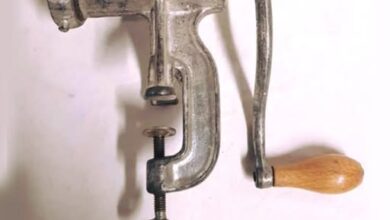
The laundry wringer sitting on that crowded table was more than an old household object waiting to be noticed. At first glance, it may have seemed like a simple antique—two rollers, a handle, a sturdy frame, and the marks of age pressed into every surface. But the longer I looked at it, the more it felt like something much deeper. It was not just a tool from the past; it was a surviving piece of a way of life that depended on patience, physical labor, routine, and the quiet strength of ordinary people.
Its worn wooden handle, darkened by years of use, seemed to hold the memory of countless hands that had turned it again and again. The iron rollers, heavy and practical, spoke of a time when laundry was not a quick task squeezed between errands, but an entire day’s work. Before modern washing machines and dryers, washing clothes required planning, endurance, and cooperation. Water had to be carried or pumped, heated, poured, and reused carefully. Clothes were scrubbed by hand, rinsed, twisted, and then fed through a wringer to squeeze out as much water as possible before being hung to dry in the sun or near the warmth of a stove.
What we now complete with the press of a button once demanded aching backs, tired arms, and hands roughened by soap, water, and cold air. Laundry was not simply a chore; it was a rhythm of life. It was part of the weekly routine that shaped households and communities. The wringer reminded me that convenience, something we often take for granted, came only after generations of people performed the same exhausting tasks with little complaint. Their work was necessary, repeated, and often invisible, yet it held families together in the most practical and meaningful ways.
I imagined the people who may have used this very wringer long before it found its way to me. Perhaps it stood beside a washtub in a farmhouse yard, surrounded by baskets of damp clothes and sheets. Perhaps it was used in a busy kitchen, where steam rose from hot water and the scent of soap filled the room. Maybe children ran nearby while adults worked, learning by watching the careful motions of washing, rinsing, wringing, and hanging. Maybe neighbors gathered on washday, sharing stories, advice, laughter, and news while their hands continued the familiar labor.
In that sense, the wringer was not only a machine. It was part of a social space. Work that seems lonely to us today was often shared. People helped one another because they had to, but also because community grew naturally around repeated tasks. The sound of water splashing, fabric being scrubbed, rollers turning, and voices rising over the steam must have made washday feel like both burden and gathering. The wringer belonged to that world—a world slower than ours, harder in many ways, but also deeply connected through shared effort.
Bringing the wringer home, I realized I had not simply purchased an antique. I had brought home a storyteller. It carried no written history, no label naming its owners, no exact record of where it had been. Yet its silence seemed full of memory. Every scratch, dent, stain, and worn edge suggested years of service. It had not been made to sit untouched on a shelf. It had been made to work. It had been built for hands that needed it, for families who depended on it, and for a time when survival and comfort were created through labor.
Now it rests on my shelf, but I do not see it as mere decoration. I see it as a reminder of the dignity of ordinary work. It asks me to remember the people whose names may never appear in history books, but whose lives were filled with responsibility, care, and endurance. These were the people who kept homes clean, children clothed, meals prepared, and families moving forward. Their efforts were repetitive and demanding, yet they were essential. The wringer honors them in a quiet way.
In today’s world, we are surrounded by speed. Machines wash, dry, heat, cool, calculate, and deliver. Tasks that once required hours can now be finished almost without thought. While this progress is valuable, it can also make us forget the human effort that came before it. The laundry wringer reminds me that every modern convenience has a history behind it. Behind the ease of pushing a button are generations of people who spent their strength doing what had to be done.
This simple tool also reminds me that history is not only found in grand buildings, famous battles, or the lives of powerful people. History lives in kitchens, washrooms, barns, basements, and backyards. It lives in objects that were touched daily, used until they wore down, repaired when they broke, and kept because they were necessary. A laundry wringer may seem small compared to the larger stories of the past, but it represents something deeply human: the struggle to care for ourselves and one another.
The longer I own it, the more I understand that its value is not measured by age, rarity, or price. Its true value lies in what it makes me feel and remember. It connects me to people I will never meet, people who worked hard with fewer comforts and fewer shortcuts. It reminds me to respect the labor that shaped everyday life and to notice the quiet tools that carried families through difficult times.
The wringer is a symbol of endurance. It represents hands that did not give up, households that found ways to manage, and communities that formed around shared work. It shows that even the most ordinary object can hold a powerful story when we take the time to listen. In its worn handle and heavy rollers, I see patience. I see strength. I see care. I see the lives of people who turned necessity into routine and routine into survival.
What began as a curious find on a crowded table has become something far more meaningful. It is a reminder that the past is never truly gone. It remains with us in the objects we save, the stories we tell, and the respect we give to those who came before us. This laundry wringer may no longer squeeze water from wet clothes, but it still performs a kind of work. It preserves memory. It invites reflection. It honors ordinary hands and ordinary lives, proving that even the smallest and simplest things can carry the deepest human stories.