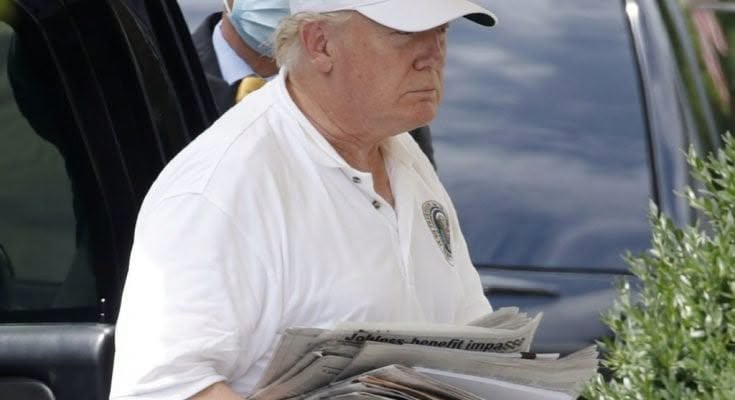
What remains after the noise fades is not the satisfaction of a solved mystery, but a revealing portrait of how quickly uncertainty can harden into narrative. A brief late-night moment, separated from its full context and reduced to a blurred detail, was enough to set off a wave of speculation. People did not simply ask what they were seeing. They began building stories around it.
The object in his hand soon became secondary.
What mattered more was what people wanted that object to represent. For some, it became proof of suspicion. For others, it became evidence of carelessness, secrecy, or weakness. Still others treated it as a harmless misunderstanding inflated by an online culture addicted to drama. Each interpretation said something, but often less about the actual scene than about the person interpreting it.
That is the strange power of ambiguity in a highly charged political environment. When the image is unclear, the imagination becomes active. When the facts are incomplete, emotion supplies the missing pieces. A single uncertain detail can become a screen onto which people project fear, loyalty, resentment, hope, or outrage. The less definite the evidence, the more room there is for certainty to be performed.
In that sense, the incident is not only about Donald Trump. It is about the atmosphere that surrounds him, and more broadly, the atmosphere surrounding public life itself. Every gesture is examined. Every frame is isolated. Every unclear moment is treated as a possible revelation. Supporters and critics alike move quickly, not always toward truth, but toward confirmation. The question becomes less “What happened?” and more “What does this allow me to believe?”
That is where the danger lies.
When attention moves faster than verification, speculation becomes its own kind of evidence. A rumor repeated enough times begins to feel like a fact. A blurry image becomes a symbol. A theory becomes a headline. By the time clearer information emerges, the story has often already done its work. People have shared it, argued over it, attached meaning to it, and placed it into the larger narrative they already carry.
The responsible response is not to ignore such moments entirely. Public figures invite scrutiny, and unexplained scenes can deserve careful attention. But there is a difference between curiosity and conclusion. There is a difference between asking questions and filling silence with certainty. The more politically charged the subject, the more important that difference becomes.
What this episode ultimately shows is how fragile the line can be between observation and invention. We see something. We interpret it. Then, almost without noticing, we begin treating our interpretation as knowledge. In the space between what is visible and what is verified, entire stories can grow.
That space demands caution.
The wisest response is to hold uncertainty honestly, not as weakness but as discipline. It means admitting that not every strange detail is a revelation. Not every unclear image contains a scandal. Not every viral moment deserves to become a verdict. Sometimes the most truthful thing to say is simply that we do not yet know.
And in a culture that rewards instant certainty, that may be the hardest thing of all.